
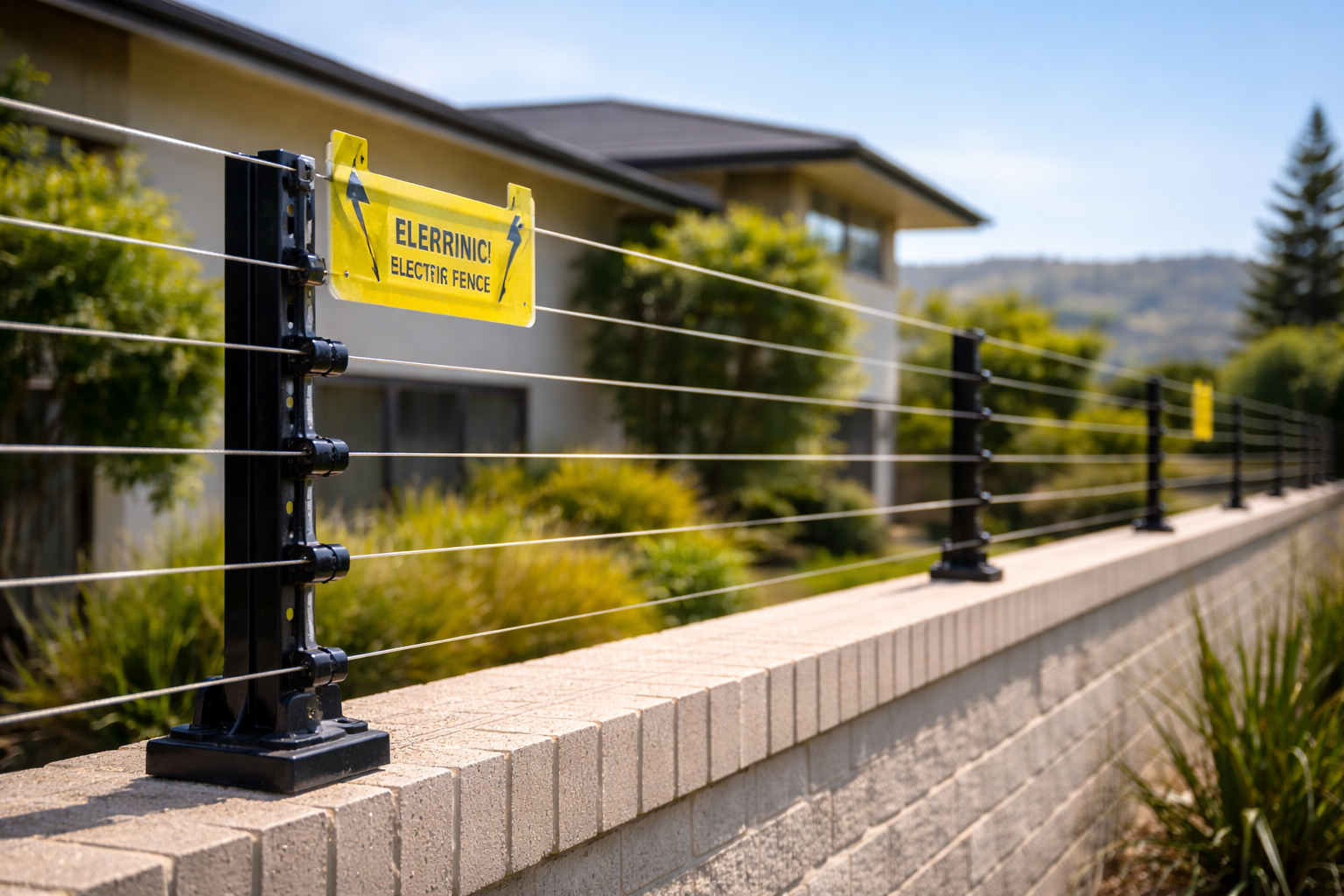
If you’re comparing electric fencing prices in Cape Town, the first thing to know is that there usually isn’t one simple flat rate.
The final price depends on whether the fence is wall-top or free-standing, how many strands you need, the condition of the boundary, the energizer you choose, and whether important extras like battery backup and compliance are included in the quote.
That is why one quote can look surprisingly cheap while another feels much higher. In many cases, the cheaper number is only the fence-line portion of the installation and does not include everything needed for a proper, reliable setup.
Some published pricing tables state clearly that their per-metre rates exclude the energizer, and sometimes also exclude items like battery backup, gate contacts, lightning protection, or the compliance certificate.
Get a Custom Electric Fencing Quote
Need a new electric fence or want to upgrade an existing setup? Send your location and a few details about the boundary, and get a practical quote based on the type of system, strand count, and what your property actually needs.
What does electric fencing usually cost in Cape Town?
For a standard residential wall-top electric fence, a practical Western Cape planning range is roughly R110 to R180 per metre for many typical installations. Across broader South African pricing guides, basic wall-top systems often start around the low hundreds per metre, with higher strand counts and more demanding specifications pushing the price up further.
For free-standing electric fencing, the price is usually much higher because the system needs its own posts and structure rather than using an existing wall. Published pricing guides commonly place free-standing systems from roughly R215 to R400+ per metre, depending on the strand count, height, and overall specification.
The reason for that gap is simple. A wall-top system uses an existing wall as the base, while a free-standing fence has to create the full structure from scratch. More posts, more material, more setup, and often more labour means a noticeably higher cost per metre.
Wall-top pricing vs free-standing pricing
For wall-top installations, pricing usually climbs as the strand count increases. One 2026 South African pricing guide shows typical ranges of about R115 to R120 per metre for 6-strand wall-top, R140 to R150 for 8-strand, and R160 to R170 for 10-strand systems.
Another installer-style table places common wall-top ranges in a similar bracket, although exact figures shift depending on distance and scope.
For free-standing installations, the same pattern applies, just at a higher level. A recent national guide shows roughly R220 to R250 per metre for 12-strand free-standing, R300 to R350 for 18-strand, and R370 to R395 for 30-strand systems. That gives you a useful sense of how quickly the cost rises once you move into more exposed or higher-security setups.
So when someone says, “electric fencing costs around this much per metre,” the real question is always: what type of electric fence, and what spec? Without that detail, the number can be misleading.
What usually pushes the price up?
The biggest cost driver is normally wall-top vs free-standing. After that, the next major factors are the number of strands, the length of the run, the condition of the wall or boundary, the number of corners and returns, and the overall complexity of the site.
Uneven sections, awkward bends, unstable wall caps, older plaster, long distances from the energizer, and difficult access can all increase labour and material costs.
In Cape Town, there is also the practical issue of wind, weather, and long-term outdoor durability. Cape Fence & Steel already leans into this on the main site, highlighting the need to consider wind exposure, coastal air, and finishes that hold up properly outside.
That matters with electric fencing too, because a perimeter system that is technically installed but not built for the local conditions can become unreliable sooner than expected.
Another thing that changes the quote quite a bit is the energizer setup. Retail and pricing guides show energizer costs spanning a wide range, often starting around R2,500 for simpler residential setups and rising to R7,800+ for larger or more feature-rich units with stronger output, extra zones, or added monitoring features.
Get a Custom Electric Fencing Quote
Need a new electric fence or want to upgrade an existing setup? Send your location and a few details about the boundary, and get a practical quote based on the type of system, strand count, and what your property actually needs.
The extras that catch people out
This is where many people underestimate the real project cost.
You may get a fence-line price per metre that sounds reasonable, only to find later that it does not include the energizer. Some pricing tables also note that battery backup, lightning protection, gate contacts, and the compliance certificate may be excluded or handled separately.
That matters a lot in practice because an electric fence is not just wires on brackets. A proper working system may also need an energizer, a battery backup for outages, a lightning diverter, gate contacts, warning signage, and a compliant final setup.
Nemtek’s training and compliance material also notes that any new electric fence installation in South Africa requires a Certificate of Compliance, and Nemtek further states that a valid COC is mandatory when selling a property with an electric fence.
So the more useful question is not just “what is the price per metre?” It is: what is included in that price per metre?
A realistic way to budget
If you are budgeting for a straightforward wall-top residential system, using roughly R110 to R180 per metre as a planning range is a sensible starting point for the fence-line part of the project in the Western Cape.
That means a 30-metre run could roughly sit around R3,300 to R5,400, while a 50-metre run could land around R5,500 to R9,000 before you start adding the energizer and other extras.
Once you add an energizer, battery backup, lightning protection, gate contact work, and any compliance-related items, the real project total can move noticeably higher. That is why two systems with the same boundary length can still end up with very different final quotes.
For a free-standing electric fence, the budgeting picture changes more sharply. At roughly R215 to R400+ per metre, a 50-metre run could already sit in a much higher range before any added equipment or special site work is included.
That is one reason free-standing electric fencing is usually chosen for more specific security needs, larger plots, or boundaries where there is no existing wall to work with.
Why some quotes look cheap
Usually because they leave something out.
A low quote might be based on fewer strands, a smaller or less capable energizer, no battery backup, simpler brackets, fewer corners, or a fence-line-only rate that excludes the equipment that actually makes the system usable day to day.
Some pricing tables are very clear that their published rates exclude the energizer, and others note that the compliance certificate may or may not be included.
That does not automatically mean the cheaper quote is wrong. It just means you should compare the actual scope, not only the bottom line. With electric fencing, two quotes can look like they are for the same job when they are actually for two very different systems.
Get a Custom Electric Fencing Quote
Need a new electric fence or want to upgrade an existing setup? Send your location and a few details about the boundary, and get a practical quote based on the type of system, strand count, and what your property actually needs.
Is electric fencing worth it in Cape Town?
For many homes, complexes, businesses, and industrial properties, yes.
Electric fencing remains one of the most practical perimeter upgrades because it adds deterrence and an active security layer without needing a full solid barrier around the property.
The value comes from getting the system right. A neat, properly tensioned, correctly powered and compliant installation is very different from a fence that was installed to hit the cheapest per-metre figure and then starts giving trouble later. In the long run, the better quote is often the one that delivers a dependable system, not just the one that looked lowest at the start.
How to compare electric fencing quotes properly
When reviewing quotes, make sure you are comparing the same specification. At minimum, check:
-
whether it is wall-top or free-standing
-
how many strands are included
-
whether the energizer is included
-
whether battery backup is included
-
whether lightning protection is included
-
whether the Certificate of Compliance is included
-
whether gate contacts, warning signs, and other essential accessories are included
-
whether the boundary condition or repair work has been allowed for
Those details are often what explain the difference between a quote that only looks cheap and one that is actually complete.
The honest takeaway on electric fencing prices in Cape Town
For most Cape Town properties, a useful starting point is to think of standard wall-top electric fencing at roughly R110 to R180 per metre, with free-standing systems usually starting much higher, often from around R215 per metre upward depending on the spec. On top of that, the energizer and related extras can materially change the final project price.
So rather than chasing the cheapest advertised number, the better approach is to get a quote based on your actual boundary, your preferred security level, and what you need included from day one. That is the only way to get a number that is genuinely useful.
Get a Custom Electric Fencing Quote
Need a new electric fence or want to upgrade an existing setup? Send your location and a few details about the boundary, and get a practical quote based on the type of system, strand count, and what your property actually needs.