
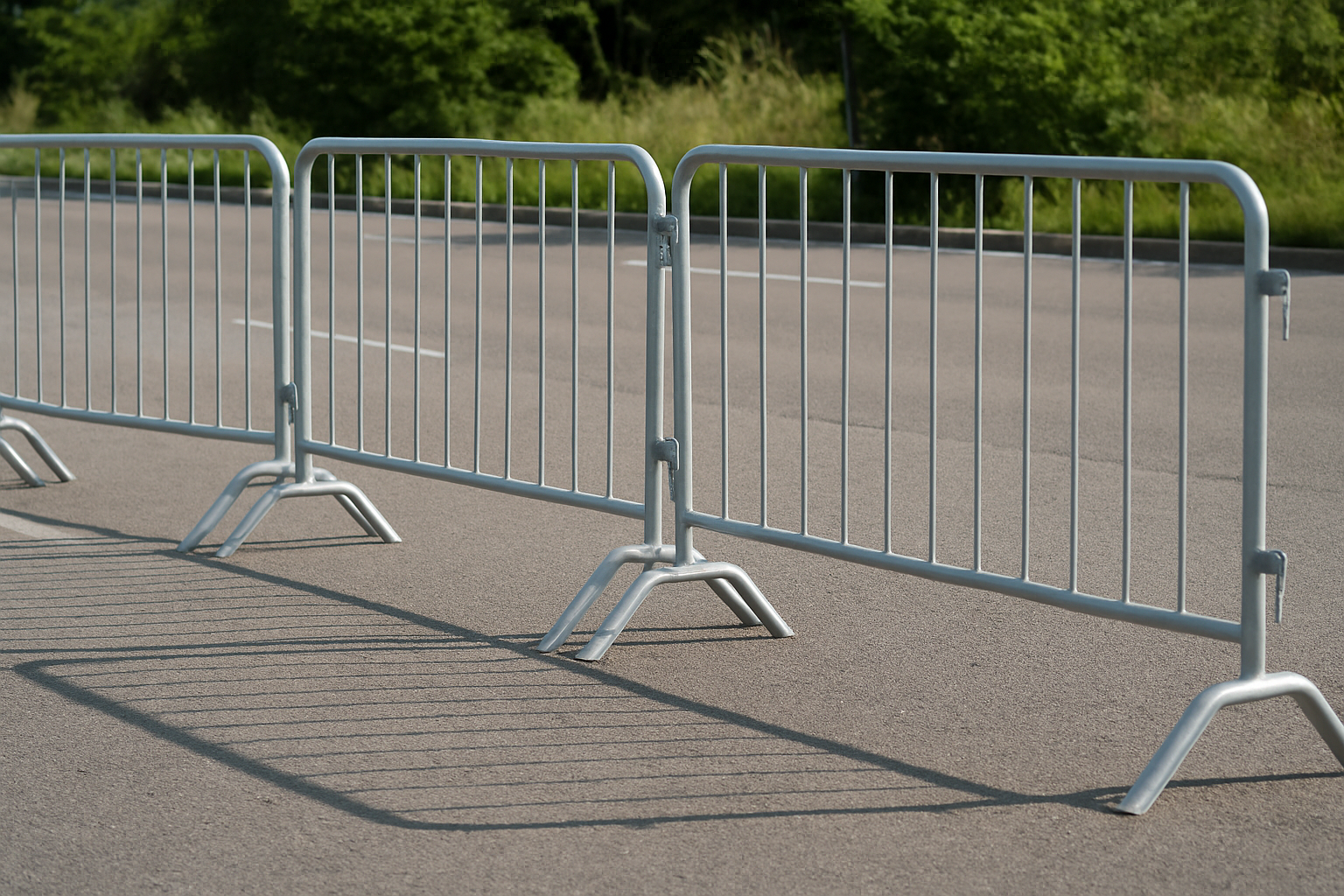
Cape Fence & Steel supplies, delivers and sets up crowd-control barricades for events, venues, businesses and temporary controlled areas across Cape Town and surrounding areas. Our steel pedestrian barriers help organise queues, define entrances, guide foot traffic and prevent access to restricted sections.
Get a Crowd-Control Barricade Quote
Fill the form below and our team will be in touch with you shortly.
Crowd-Control Barricades for Cape Town Events
Crowd-control barricades create visible pedestrian boundaries that help people understand where to queue, enter, exit or avoid. They can be arranged in straight lines, lanes, corners and enclosed sections according to the layout of the venue.
Cape Fence & Steel provides steel barricades for public events, private functions, sporting activities, festivals, exhibitions, markets, corporate gatherings and other temporary occasions across Cape Town.
The barrier arrangement should reflect how people are expected to move through the site. A queue outside an entrance requires a different layout from a protected performance area, registration point or temporary pedestrian route.
Entrances and exits must remain easy to identify, while service routes and emergency access should not be blocked. We consider the venue layout, expected attendance and areas requiring separation before arranging the barricades.
Event Barricades for Entrances and Ticketing Areas
Entrances are often where crowd movement becomes most concentrated. Guests may need to present tickets, pass through security, collect accreditation or wait for access to open.
Barricades can create organised queue lanes leading toward the entrance and help prevent people from approaching the access point from several directions at once.
The layout should provide enough space for the expected number of guests without forcing queues into roads, driveways or unrelated pedestrian areas. It should also allow staff to move between lanes and respond where assistance is needed.
Separate routes may be created for general admission, ticket collection, VIP access, staff, service providers or people requiring assistance.
Where security checks are conducted, the barriers can help define the waiting area and maintain a clear route through the checkpoint.
Queue Barriers for Cape Town Businesses and Venues
Crowd-control barriers are useful wherever people need to wait in an organised way. This may include retail promotions, product launches, registration desks, transport points, clinics, offices, collection areas and temporary service counters.
A clearly marked queue helps reduce confusion and prevents people from blocking entrances, walkways or operating areas.
The lane width should allow people to move comfortably without creating unnecessary gaps that encourage queue jumping. Turns should not be so tight that movement becomes difficult, particularly where guests may be carrying bags, equipment or pushchairs.
Barriers can also create a separate exit route so that people leaving the service point do not move against the incoming queue.
For longer queues, the layout can be divided into controlled sections that staff release progressively as space becomes available.
Get a Crowd-Control Barricade Quote
Fill the form below and our team will be in touch with you shortly.
Pedestrian Barriers and Walking Routes
Events and commercial sites often need to guide pedestrians through areas where vehicles, equipment or operational activity are also present.
Barricades can create a visible walking route between parking areas, entrances, ticket points, seating areas and other parts of a venue. They can also help prevent pedestrians from taking shortcuts through loading zones, temporary work areas or vehicle access routes.
The route should remain wide enough for the expected pedestrian volume. Narrow paths can become congested and may be difficult to use when people are moving in both directions.
Where possible, incoming and outgoing pedestrians should be separated at busy points. This helps reduce opposing movement and allows crowds to continue flowing instead of stopping around entrances.
Changes in direction should remain clear, especially at night or in large venues where guests may not be familiar with the property.
Barriers for Restricted and Operational Areas
Some sections of an event or business site need to remain accessible only to staff, contractors, performers, exhibitors or authorised personnel.
Crowd-control barricades can be positioned around backstage areas, equipment zones, temporary offices, service entrances, control points and other operational sections.
The barriers provide a clear visual indication that the area is restricted, reducing the likelihood of visitors entering accidentally.
They can also protect cables, equipment or temporary installations that should remain separated from normal pedestrian movement. The layout must still allow authorised workers to access the area without repeatedly dismantling the barrier line.
Where stronger perimeter security is required, crowd-control barriers may not be sufficient on their own. Temporary fence panels can provide a taller and more enclosed boundary around equipment, storage areas and larger restricted zones.
Crowd-Control Barriers for Markets and Exhibitions
Markets, trade shows and exhibitions may need defined routes between stalls, stages, demonstration areas and entrances.
Barricades can help create queueing space at popular stalls or activities without allowing waiting customers to block the main circulation routes.
They can also separate public areas from exhibitor loading points, storage sections and behind-the-scenes operations.
The arrangement should account for where people are likely to gather rather than only following the edges of the venue. Food stalls, registration desks, entertainment areas and giveaway points often create temporary congestion that may need dedicated queue space.
As attendance patterns change, movable barriers can be repositioned to improve circulation or open additional lanes.
Get a Crowd-Control Barricade Quote
Fill the form below and our team will be in touch with you shortly.
Barricades for Sporting Events and Races
Sporting events may require barriers around start and finish areas, registration points, spectator zones and sections where participants move through public spaces.
Barricades can define running or cycling routes, protect timing and equipment areas and keep spectators clear of active sections.
The barrier line should remain visible and continuous, particularly where participants change direction or move close to spectators.
Start and finish areas often experience high concentrations of people, including participants, officials, spectators and event staff. Separate access routes can help prevent these groups from moving against each other.
Where vehicle routes cross the event area, the layout must be carefully controlled so that pedestrians and participants are not directed into active traffic.
Crowd-Control Barricades for Concerts and Performances
Concerts, performances and entertainment events may require barriers around stages, sound equipment, backstage entrances and audience-controlled areas.
Barricades can help establish distance between guests and equipment while creating clear working space for technicians, performers and security personnel.
The suitability of standard pedestrian barricades depends on the event size, audience behaviour and expected pressure against the barrier line. Events with highly energetic or tightly packed crowds may require specialised event infrastructure and professional crowd-management planning beyond ordinary movable barriers.
For smaller performances, community events, markets and controlled audience areas, steel barricades can provide an effective visible separation when used as part of a properly managed layout.
Emergency routes, staff access and evacuation paths must remain clear throughout the event.
Barricades for Commercial and Industrial Properties
Businesses and industrial properties may need temporary pedestrian barriers during maintenance, construction, deliveries, equipment installation or changes to normal access routes.
Barricades can guide staff and visitors away from loading areas, vehicle routes, wet surfaces, damaged walkways or sections where contractors are working.
They are also useful when one entrance is temporarily closed and pedestrians must be redirected to another part of the property.
The barrier arrangement should not create new hazards by forcing people into traffic, machinery areas or narrow routes. The alternative path must remain practical and easy to understand.
For longer projects or areas requiring greater protection, temporary fencing may be more suitable than low pedestrian barricades.
Get a Crowd-Control Barricade Quote
Fill the form below and our team will be in touch with you shortly.
Crowd-Control Barricades and Temporary Fencing
Crowd-control barricades and temporary fence panels serve different purposes.
Barricades are generally lower and designed to organise people, create queues and guide pedestrian movement. They can be repositioned relatively easily as attendance patterns and access requirements change.
Temporary fencing creates a taller and more substantial perimeter. It is better suited to construction sites, vacant properties, equipment areas and zones that must remain closed to public access.
An event or work site may require both systems. Temporary fence panels can secure the outer boundary or backstage area, while crowd-control barricades manage queues and pedestrian routes closer to entrances.
Choosing the correct barrier for each part of the site creates a clearer layout than using one system for every purpose.
Planning an Effective Crowd-Control Layout
A successful barricade layout begins with understanding where people will arrive, where they need to go and which areas they should not enter.
The expected attendance, arrival times and number of access points influence the amount of queueing space required. Events where most guests arrive shortly before opening may need more extensive entrance lanes than occasions with steady arrivals throughout the day.
The position of parking areas, public transport drop-off points and surrounding pavements also affects how crowds approach the venue.
Inside the site, barriers should support natural movement. Routes that require unnecessary turns or direct people away from obvious destinations may be ignored or cause confusion.
The plan should also consider:
- Main entrances and exits
- Ticketing and registration points
- Security checkpoints
- Pedestrian and vehicle crossings
- Accessible routes
- Staff and supplier entrances
- Restricted operational areas
- Emergency and service access
- Areas where crowds are likely to gather
The final arrangement should remain understandable even to visitors seeing the venue for the first time.
Barricade Stability on Different Surfaces
Crowd-control barricades may be installed on concrete, paving, asphalt, compacted soil, grass and temporary event surfaces.
The ground should be reasonably level so that the feet sit securely and the barricades connect without excessive movement.
Uneven paving, loose gravel and sloping ground can cause barriers to rock or lean. The layout may need to be adjusted to avoid the most unstable sections or provide additional support where appropriate.
Barricades should not be positioned over potholes, drainage channels or areas where pedestrians may trip against the feet.
The surrounding surface should also be checked during longer events, particularly after rain or heavy foot traffic. Soft ground can become uneven and reduce stability.
Get a Crowd-Control Barricade Quote
Fill the form below and our team will be in touch with you shortly.
Crowd Barriers for Cape Town Wind Conditions
Cape Town’s strong winds must be considered when barricades are used outdoors.
Open steel barricades allow air to pass through more easily than solid barriers, but exposed lines can still move when wind pressure acts across connected sections.
Corners, changes in direction and longer connected lines can improve stability compared with isolated individual barriers. The exact arrangement depends on the site and the direction from which wind is expected.
Banners, boards, fabric and branding should not be attached without considering their effect on wind resistance. A lightweight open barricade can behave very differently once a solid covering has been added.
The barriers should be checked after strong gusts and throughout longer outdoor events. Any units that have shifted, separated or begun leaning should be corrected promptly.
Highly exposed venues near the coast, on elevated ground or in large open spaces may require additional planning and support.
Delivery, Setup and Collection
Crowd-control barricades should arrive with enough time for the layout to be completed before guests, customers or participants begin entering the site.
The delivery area must be accessible without disrupting other event preparation. Barriers should be unloaded in a location that allows them to be moved into position without blocking entrances or vehicle routes.
During setup, the planned queue lanes, boundaries and restricted areas are established according to the available site information.
Where the event layout changes, barricades can be repositioned to create additional access points, expand queues or close sections that are no longer in use.
After the event or temporary requirement ends, the barriers can be removed so that normal pedestrian and vehicle movement can resume.
The project requirements should be discussed in advance where delivery times, venue access or collection arrangements are restricted.
Moving Barriers During an Event
Crowd patterns can change after an event begins. A queue that was expected at one entrance may develop at another, or an area may need to be opened as attendance increases.
Barricades can be repositioned, but changes should be made in a controlled manner. Removing individual barriers without considering the full line can create gaps, unstable sections or unclear pedestrian routes.
Staff should understand which openings are authorised and which restricted areas must remain closed.
Changes should not block emergency exits, accessible routes or operating equipment. Vehicle and pedestrian movement must also be reconsidered when a barrier line is moved.
For larger events, a responsible person should oversee layout changes so that separate teams do not alter different sections without coordinating the overall plan.
Get a Crowd-Control Barricade Quote
Fill the form below and our team will be in touch with you shortly.
Using Barricades Safely Around the Public
Barricades should be clearly visible and arranged without creating avoidable trip hazards.
Feet and supporting components should not project unexpectedly into narrow pedestrian routes. Corners and ends should be positioned where people can see and move around them comfortably.
Damaged barriers with sharp edges, broken welds or unstable feet should not remain in use.
Children should not be allowed to climb, sit on or move the barriers. The units are intended to guide and separate pedestrians, not to serve as seating or play equipment.
The barrier layout must also be appropriate for the expected crowd. Standard pedestrian barricades should not be relied upon as the only protective system where substantial crowd pressure, aggressive behaviour or vehicle impact is foreseeable.
Event organisers remain responsible for wider crowd management, staffing, emergency planning and venue safety.
What Affects Crowd-Control Barricade Prices?
Crowd-control barricade costs depend on the number of barriers required, delivery arrangements, setup complexity and duration of use.
A short queue outside one entrance requires fewer units than an event with several ticket lanes, pedestrian routes and restricted zones.
The quotation may also be influenced by:
- Venue location and delivery access
- Total barrier quantity
- Number of separate areas
- Queue-lane configuration
- Setup and repositioning requirements
- Duration of the event or project
- Collection timing
- Outdoor wind exposure
- Uneven or difficult surfaces
- After-hours delivery or access restrictions
Providing a venue plan, photographs or a basic sketch can help show the entrance points and areas that need to be controlled.
The expected attendance and peak arrival period are also useful when estimating the amount of queue space required.
Get a Crowd-Control Barricade Quote
Fill the form below and our team will be in touch with you shortly.
Crowd-Control Barricades Across Cape Town and Surrounding Areas
Cape Fence & Steel supplies and sets up crowd-control barricades across Cape Town and surrounding areas.
We assist event organisers, venues, businesses, markets, construction sites and commercial properties throughout the Northern Suburbs, Southern Suburbs, West Coast, City Bowl, Atlantic Seaboard, Cape Flats, South Peninsula, Helderberg and nearby Winelands areas.
Be it you’re in Goodwood, Edgemead, Monte Vista, Maitland, Pinelands, Cape Town City Bowl, Green Point, Camps Bay, Hout Bay, Sea Point, Observatory, Rondebosch, Newlands, Claremont, Kenilworth, Wynberg, Plumstead, Constantia, Tokai, Bergvliet, Muizenberg, Fish Hoek, Noordhoek, Athlone, Lansdowne, Ottery, Grassy Park, Epping Industria, Montague Gardens, Airport Industria, Parow, Bellville, Milnerton, Durbanville, Brackenfell, Kraaifontein, Kuils River, Bloubergstrand, Melkbosstrand, Simon’s Town, Mitchells Plain, Blue Downs, Eerste River, Stellenbosch, Somerset West, Strand, Gordon’s Bay, Paarl, and surrounding areas.
Contact us with the venue location, event date, expected attendance and the areas that need to be separated or controlled.
Get a Crowd-Control Barricade Quote in Cape Town
Organise queues, define pedestrian routes and protect restricted areas with practical steel crowd-control barricades.
Contact Cape Fence & Steel for barricade supply, delivery, setup, repositioning and collection across Cape Town and surrounding areas.
Get a Crowd-Control Barricade Quote
Fill the form below and our team will be in touch with you shortly.