
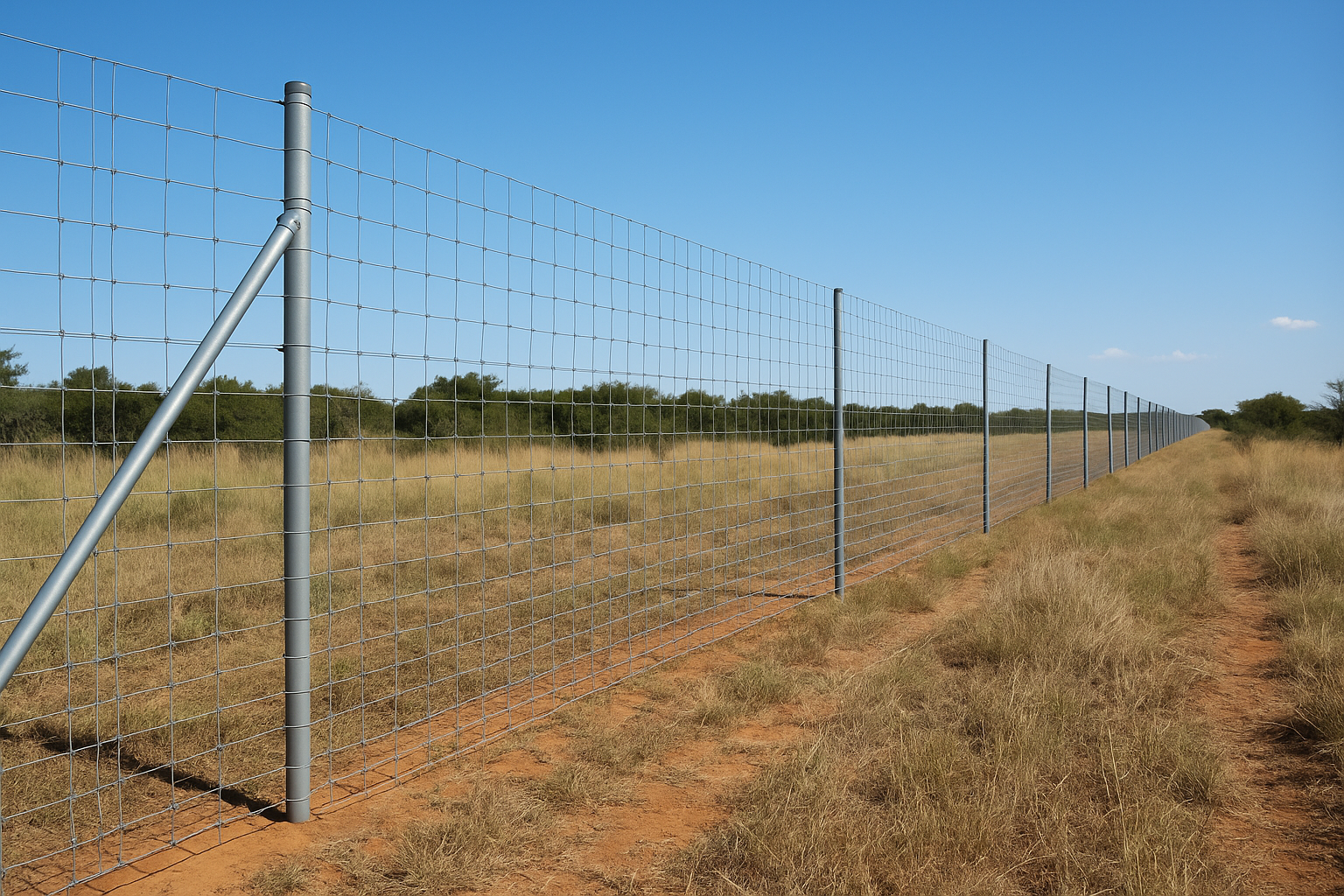
Cape Fence & Steel installs, repairs and extends game fencing for farms, smallholdings, estates and larger properties across Cape Town and surrounding areas. We plan each fence around the animals being contained, the terrain, perimeter length, access gates and conditions along the boundary.
Get a Game Fencing Quote
Fill the form below and our team will be in touch with you shortly.
Game Fence Installation in Cape Town
Game fencing is used to contain animals, protect selected areas and create secure boundaries across larger properties. Unlike ordinary residential fencing, it must account for long perimeter distances, uneven terrain, animal behaviour and the pressure placed on posts, mesh and gates.
Cape Fence & Steel installs new game fences, replaces deteriorated boundaries and extends existing enclosures. We assist with perimeter fencing, internal divisions, animal camps and controlled access points for suitable agricultural, equestrian, wildlife and lifestyle properties.
The correct specification depends on what the fence must contain or exclude. Fence height, mesh size, wire strength, post spacing and lower-ground protection should be selected around the animals and the conditions of the property rather than applying one standard design to every site.
A properly planned installation should remain consistent across slopes, drainage routes, corners and changes in ground level without leaving avoidable gaps beneath the fence.
Game Fencing for Farms, Smallholdings and Estates
Properties on the outskirts of Cape Town and in nearby Winelands areas often have larger boundaries than conventional suburban sites. They may need fencing around grazing areas, vineyards, paddocks, animal enclosures, conservation sections or the complete property perimeter.
Game fencing can be suitable for:
- Farms and agricultural properties
- Smallholdings and lifestyle plots
- Equestrian and animal-care properties
- Wine and hospitality estates
- Private nature and conservation areas
- Larger residential estates
- Internal camps and controlled sections
- Boundaries adjoining open land
The fence design should reflect how the property is used. A boundary intended mainly to define land and deter casual entry may require a different specification from an enclosure containing active or larger animals.
Vehicle routes, staff access, maintenance paths and service entrances should be considered during planning so that the fence supports daily operations rather than creating inconvenient access problems.
Get a Game Fencing Quote
Fill the form below and our team will be in touch with you shortly.
Choosing the Right Game Fence Height and Mesh
Game fencing is available in different heights and mesh configurations. The appropriate option depends on the animals involved, the purpose of the enclosure and whether the fence must prevent animals from climbing, jumping, pushing through or passing beneath it.
Smaller mesh openings near the bottom can help contain younger or smaller animals. Taller fencing may be required where animals are capable of jumping or where the surrounding terrain reduces the effective height of the boundary.
The fence should not be selected only according to the highest point of the mesh. Post strength, line tension, intermediate supports and the condition of the ground all influence how the completed system performs.
For properties containing specialised, valuable or potentially dangerous wildlife, the fence specification should be planned around the relevant professional, regulatory and animal-management requirements. A general agricultural fence should not be assumed to be suitable for every species.
Game Fencing for Cape Town’s Varied Terrain
Larger properties around Cape Town, Stellenbosch, Paarl, Somerset West and the northern outskirts can include slopes, rocky ground, sandy sections, seasonal water routes and uneven boundary lines.
The fence must follow the terrain closely enough to prevent large openings beneath the mesh. On steep ground, the installation may need to step or adapt gradually so that the fence remains secure without becoming badly distorted.
Low areas and drainage routes require careful attention. Heavy winter rain can move soil, debris and vegetation against the fence or wash material away from beneath it.
Rocky ground may affect where posts can be installed and how they should be anchored. Sandy or loose soil may require stronger foundations or closer attention to bracing so that posts do not move under line tension.
The installation method should respond to the conditions along each part of the boundary rather than treating the entire property as uniform.
Posts, Strainers and Long Fence Lines
Long game fence lines place continuous tension on posts, corners and end assemblies. Strong strainers and correctly positioned braces are essential for keeping the mesh upright and properly tensioned.
Corner posts, changes in direction and gate openings carry more load than ordinary intermediate posts. These points should be reinforced so that movement in one section does not affect the surrounding fence.
Post spacing depends on the terrain, mesh specification and pressure expected along the boundary. Posts positioned too far apart can allow the mesh to sag, move excessively or become easier for animals to push beneath.
The fence should remain firm without being tensioned so aggressively that posts are pulled out of position or the mesh becomes damaged.
Careful setting out at the beginning of the project helps maintain straight lines, consistent height and stronger connections around corners and gates.
Get a Game Fencing Quote
Fill the form below and our team will be in touch with you shortly.
Game Fencing Gates and Property Access
Every larger property needs practical access for vehicles, workers, equipment and animal management.
Game fencing gates may be required at main entrances, service routes, internal camps and maintenance paths. The width and design of each gate should suit the vehicles and machinery expected to use it.
A gate that is too narrow can interfere with deliveries, tractors, trailers or emergency access. A gate that is unnecessarily wide may require heavier framing, stronger hinges and more substantial supporting posts.
The gate should close securely and connect neatly with the surrounding mesh without leaving openings around the sides or beneath the frame.
Cape Fence & Steel can fabricate steel swing gates, sliding gates and pedestrian gates for suitable game fencing applications. Where automation is required at the main entrance, the gate structure and motor requirements should be planned together.
Internal Camps and Dividing Larger Properties
Game fencing can be used to divide a property into separate camps or management areas.
Internal fencing may help separate animal groups, protect cultivation areas, control grazing or restrict access to selected sections of the land. These internal boundaries may not always require the same height or specification as the outer perimeter.
The layout should consider water points, feeding areas, shelter, movement routes and the practical operation of gates between camps.
Poorly positioned internal fencing can make routine work more difficult or create narrow corners where animals gather and place repeated pressure on the fence.
Planning the divisions before installation allows gates and access routes to be positioned where they will be useful in everyday operation.
Protecting Crops, Gardens and Sensitive Areas
Game and agricultural fencing can also help protect vineyards, orchards, gardens and landscaped areas from animals moving through the property.
The fence may be installed around a specific cultivation area rather than the full property boundary. This can be a practical option where only selected sections need protection.
Smaller animals may require closer mesh near ground level, while burrowing or digging pressure may need additional attention along the bottom of the fence.
Vegetation should be kept from growing heavily through the mesh. Thick growth can hide damage, make inspection difficult and place continuous pressure on the fence line.
Where animals are entering from neighbouring land or open areas, the route and likely pressure points should be considered before the fence layout is finalised.
Get a Game Fencing Quote
Fill the form below and our team will be in touch with you shortly.
Game Fence Repairs in Cape Town
Game fencing can be damaged by animals, vehicles, fallen branches, fire, corrosion, soil movement and severe weather.
Cape Fence & Steel repairs loose mesh, leaning posts, failed strainers, damaged gates and sections where the fence has lifted or separated from the ground.
Damage should be assessed beyond the visible opening. A broken section may have released tension along a much longer part of the fence, affecting nearby posts and connections.
Common repair requirements include:
- Re-tensioning loose or sagging mesh
- Replacing damaged posts and strainers
- Closing gaps beneath the fence
- Repairing vehicle and impact damage
- Replacing damaged mesh sections
- Correcting leaning fence lines
- Repairing gate posts and hinges
- Extending or connecting existing fences
Where the original fence is badly deteriorated or incorrectly specified, repeated local repairs may not provide a dependable result. Rebuilding the affected section can sometimes offer better long-term value.
Extending and Upgrading Existing Game Fencing
A property may need its existing game fence extended as new land is brought into use, internal camps are added or the boundary changes.
New sections should connect securely with the existing fence and maintain suitable height, mesh alignment and tension. Weak joining points can become vulnerable even when both fence sections are individually strong.
Older fences can also be upgraded by strengthening corners, replacing weak posts, improving lower-ground protection or installing more suitable gates.
Where animals or property use have changed, the existing specification should be reconsidered. A fence that was adequate for the previous application may not be appropriate for a different species or a more intensively used enclosure.
Cape Fence & Steel can assess which parts of the existing installation are worth retaining and where replacement or reinforcement is required.
Game Fencing for Cape Town Weather Conditions
Game fencing across Cape Town and the surrounding Winelands may be exposed to strong winds, winter rainfall, dry summer conditions and coastal air.
Wind can place repeated pressure on long fence lines, especially where vegetation or debris becomes caught in the mesh. Secure strainers, braced corners and suitable post spacing help the installation remain stable.
Winter rain can soften soil around posts and alter drainage routes. Water flowing along or beneath the fence may create gaps, move loose ground or collect debris against the mesh.
Properties closer to the coast may experience faster corrosion around wire, steel posts, gates, hinges and damaged protective finishes. Materials and maintenance requirements should reflect the level of exposure.
Seasonal vegetation growth must also be managed. Trees and branches should not be allowed to lean continuously against the fence, and thick growth should be cleared so that damage remains visible during inspections.
Get a Game Fencing Quote
Fill the form below and our team will be in touch with you shortly.
Maintaining a Long Game Fence Perimeter
Long fence lines should be inspected regularly because small problems can remain unnoticed until they affect a larger section.
Inspections should focus on gates, corners, strainers, low ground, drainage crossings and areas where animals frequently gather. These points generally experience greater movement and pressure.
Loose mesh should be corrected before it sags further or allows animals to pass underneath. Damaged posts should also be replaced before the surrounding line loses tension.
Vegetation, fallen branches and materials caught against the fence should be removed. These can increase wind pressure and make it difficult to identify damaged wire or mesh.
Maintenance is particularly important after heavy rain, strong wind, fire, construction work or vehicle activity near the boundary.
Game Fencing or Standard Farm Fencing?
Game fencing and general farm fencing can overlap, but they are not always intended for the same applications.
Standard agricultural fencing may be suitable for livestock divisions, crop protection and general property boundaries. Game fencing is typically taller or more specialised where animals are more likely to jump, climb or place pressure on the enclosure.
The correct choice depends on the animals, the risk of escape, the surrounding land and the consequences of a fence failure.
Some properties may use different fence specifications in different areas. A stronger outer game fence can secure the main perimeter, while simpler agricultural fencing divides internal camps.
Cape Fence & Steel can assess the site and recommend an appropriate fence layout rather than applying one specification across the entire property.
What Affects Game Fencing Prices?
Game fencing prices depend on the perimeter length, fence height, mesh specification and conditions of the property.
Long boundaries require more mesh, posts, strainers and installation time. Steep slopes, rocky ground and difficult vehicle access can also affect the work required.
Other pricing factors include the number of corners, gates, internal divisions and drainage crossings. Removing an old fence, clearing the proposed fence line and repairing existing structures may add to the project scope.
The quotation may be influenced by:
- Total boundary length
- Fence height and mesh configuration
- Post type and spacing
- Corner and strainer assemblies
- Number and size of gates
- Ground and terrain conditions
- Vegetation clearing
- Removal of damaged fencing
- Internal camps and dividing fences
- Distance and access across the property
A site assessment helps confirm the route, terrain and installation requirements before a detailed quotation is prepared.
Get a Game Fencing Quote
Fill the form below and our team will be in touch with you shortly.
Game Fencing Across Cape Town and Surrounding Areas
Cape Fence & Steel installs and repairs game fencing across Cape Town and surrounding areas, including suitable farms, smallholdings, estates and larger properties in the northern outskirts, West Coast, Helderberg and nearby Winelands.
Be it you’re in Goodwood, Edgemead, Monte Vista, Maitland, Pinelands, Cape Town City Bowl, Green Point, Camps Bay, Hout Bay, Sea Point, Observatory, Rondebosch, Newlands, Claremont, Kenilworth, Wynberg, Plumstead, Constantia, Tokai, Bergvliet, Muizenberg, Fish Hoek, Noordhoek, Athlone, Lansdowne, Ottery, Grassy Park, Epping Industria, Montague Gardens, Airport Industria, Parow, Bellville, Milnerton, Durbanville, Brackenfell, Kraaifontein, Kuils River, Bloubergstrand, Melkbosstrand, Simon’s Town, Mitchells Plain, Blue Downs, Eerste River, Stellenbosch, Somerset West, Strand, Gordon’s Bay, Paarl, and surrounding areas.
We assist with new perimeter fencing, internal camps, extensions, repairs and matching steel gates.
Contact us with the property location, approximate boundary length, terrain and animals involved so that we can confirm service availability and discuss the most appropriate fencing solution.
Get a Game Fencing Quote in Cape Town
Secure your farm, smallholding, estate or larger property with game fencing planned around the animals, terrain and daily use of the land.
Contact Cape Fence & Steel for new game fence installations, repairs, extensions, internal camps and matching gates across Cape Town and surrounding areas.
Get a Game Fencing Quote
Fill the form below and our team will be in touch with you shortly.